

If you have ever watched business news or browsed financial websites, you have certainly heard about Bank Nifty. On May 1, 2026, Bank Nifty closed at 54,863 – having traded between 54,700 and 55,600 in today’s volatile session alone. This single index moves hundreds of billions of rupees in options premium daily, making it the most actively traded derivatives contract in the world. But what exactly is Bank Nifty, how does it work, and how can you trade it profitably? This comprehensive beginner’s guide covers everything you need to know.
What is Bank Nifty?
Bank Nifty, officially known as the Nifty Bank Index, is a sectoral index maintained by the National Stock Exchange of India (NSE). It tracks the performance of the 12 most liquid and large-capitalisation banking stocks listed on the NSE. In simple terms, Bank Nifty tells you how India’s banking sector as a whole is performing on any given day.
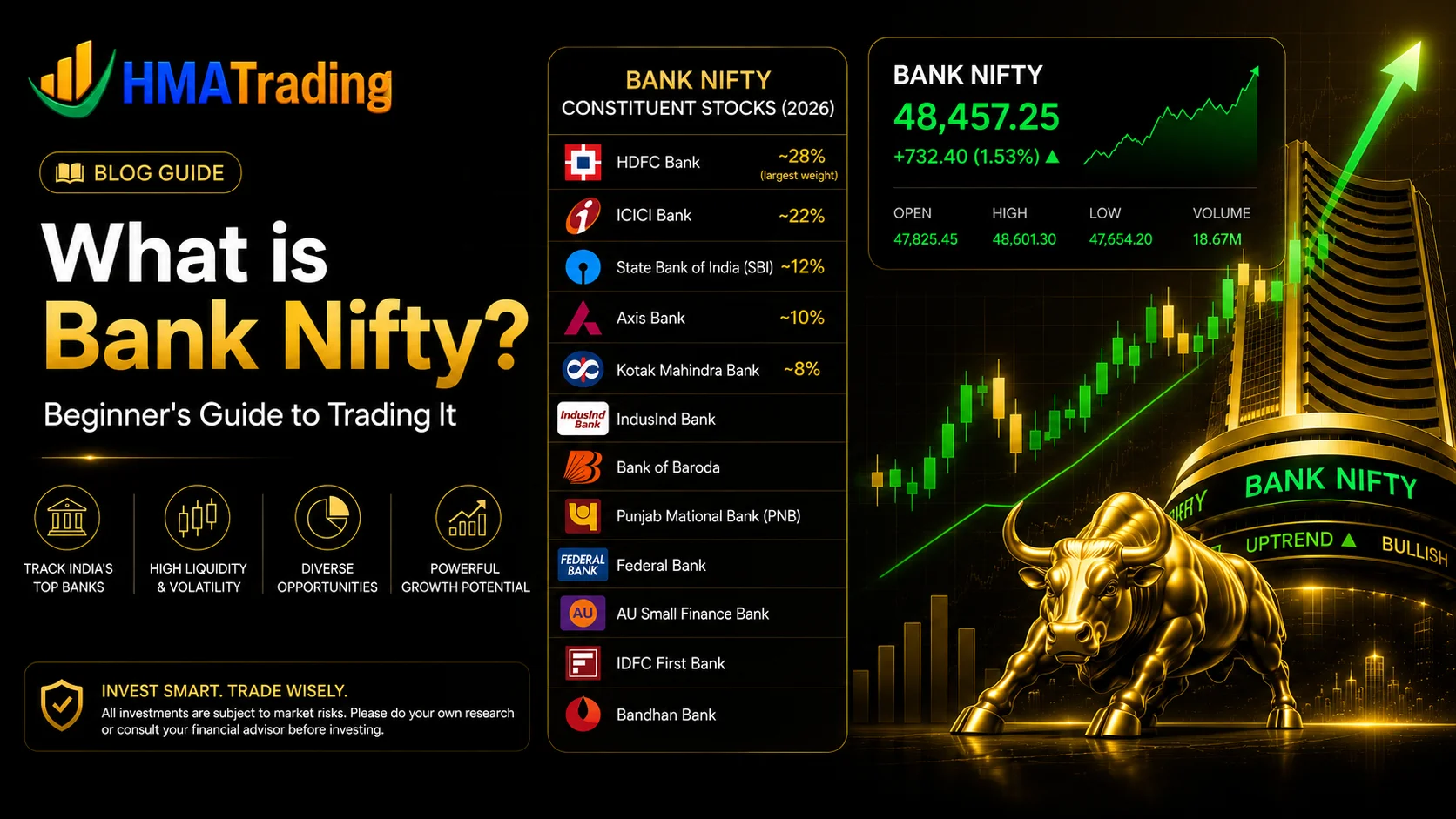
When Bank Nifty rises, it means banking stocks are broadly advancing. When it falls – as it did today by 540 points – banking stocks are declining. The index is recalculated in real time during market hours and serves as the underlying for some of the most traded futures and options contracts in the world.
Bank Nifty Constituent Stocks (2026)
- HDFC Bank (largest weight – ~28%)
- ICICI Bank (~22%)
- State Bank of India (SBI) (~12%)
- Axis Bank (~10%)
- Kotak Mahindra Bank (~8%)
- IndusInd Bank
- Bank of Baroda
- Punjab National Bank (PNB)
- Federal Bank
- AU Small Finance Bank
- IDFC First Bank
- Bandhan Bank
HDFC Bank and ICICI Bank together account for over 50% of the index weight. This means if HDFC Bank drops 2% on a bad day, Bank Nifty can fall 250–300 points even if all other banks are flat – a crucial insight for traders.
Why is Bank Nifty So Popular Among Traders?
- Exceptional Volatility: Bank Nifty regularly moves 500–1,000 points in a single trading session. Today’s 540-point swing is completely normal. This volatility creates regular opportunities for both buyers and sellers of options.
- World-Class Liquidity: The Bank Nifty options market has some of the tightest bid-ask spreads in the world. You can enter and exit positions worth crores in seconds without impacting the market price.
- Weekly Expiry (Wednesday): Bank Nifty options expire every Wednesday, allowing traders to take fresh directional bets with just 2–5 days of time horizon.
- Leverage Without Unlimited Risk (for option buyers): Buying a Bank Nifty option requires only the premium payment (typically ₹5,000–₹20,000 per lot), while giving exposure to moves worth lakhs.
- Excellent Technical Behaviour: As an index of 12 large banks, Bank Nifty tends to respect Fibonacci levels, support and resistance zones, and moving averages very reliably – making technical analysis highly effective.
Current Bank Nifty Scenario – May 2026
Bank Nifty is currently at 54,863. Key levels to watch this month:
- Immediate Resistance: 55,500 | 56,000
- Strong Resistance: 56,400–56,800
- Immediate Support: 54,000 | 53,500
- Strong Support: 52,500–53,000
How to Trade Bank Nifty – Three Methods
1. Bank Nifty Futures
A Bank Nifty futures contract has a lot size of 15 units. With Bank Nifty at 54,863, one lot controls approximately ₹8.23 lakh of notional value. If Bank Nifty moves 100 points in your favour, you make ₹1,500 (100 × 15). Every point of Bank Nifty = ₹15 profit or loss per lot.
Futures are ideal for experienced traders with large capital who want a direct, linear payoff from Bank Nifty’s price movement.
2. Bank Nifty Options (Most Popular)
- Buy a Call Option (CE) → You expect Bank Nifty to rise. If Bank Nifty is at 54,863 and you buy a 55,000 CE for ₹200 premium, and Bank Nifty reaches 55,400 by expiry, your option is worth ₹400 – a 100% return.
- Buy a Put Option (PE) → You expect Bank Nifty to fall. If Bank Nifty drops 500 points to 54,363, your 54,500 PE would be deep in the money.
- Option Selling (Writing) → Collect premium by selling options. Advanced strategy – only for experienced traders with significant capital as risk is theoretically unlimited.
3. Bank Nifty ETFs (For Investors)
If you want long-term exposure to the banking sector without the complexity of derivatives, Bank Nifty ETFs (Nippon India ETF Bank BeES, Motilal Oswal Bank Nifty ETF) are ideal. Buy units on your Demat account like any stock – no expiry, no margin requirements, no daily monitoring needed.
Key Factors That Move Bank Nifty
- RBI Policy Decisions: Rate cuts boost bank profitability → bullish. Rate hikes squeeze margins → bearish.
- HDFC Bank & ICICI Bank Quarterly Results: These two alone can move Bank Nifty 500+ points on results day.
- Credit Growth Data (RBI Monthly): Higher credit growth = more loan business = bullish for banks.
- NPA (Non-Performing Assets) Trends: Falling NPAs are bullish; rising NPAs are a red flag.
- FII Activity: FIIs own 35–45% of major private banks. Sustained FII selling creates sharp Bank Nifty declines.
- Global Banking Sector Stress: Any international banking crisis can trigger sympathy selling in Indian bank stocks.
Simple Beginner Strategies for Bank Nifty
Strategy 1: Buy at Strong Support, Sell at Resistance
For example, with Bank Nifty at 54,863, a long position near the 54,000 support zone (with a stop loss at 53,400) targeting 55,500 offers a clean 3:1 risk-reward ratio. This is the simplest and most effective strategy for beginners.
Strategy 2: Event-Based Options Buying
On RBI policy days, major bank results, and Union Budget, Bank Nifty can move 800–1,500 points. Buying both a Call and Put simultaneously (a straddle at the current level of 54,863, for example) allows you to profit from the large move regardless of direction. The key is entering before implied volatility spikes and exiting right after the event.
Strategy 3: Trend Following with Moving Averages
Bank Nifty respects its 20-day and 50-day moving averages very well. When Bank Nifty is above both MAs → trend is bullish, stay long. When it breaks below the 20-DMA with volume → exit longs and look for short opportunities. Currently, Bank Nifty is testing its 20-DMA near 54,800 – a crucial level to watch.
Common Mistakes Beginners Make
- No stop loss – Bank Nifty can move 400–600 points against you within 30 minutes on a volatile day. A stop loss is non-negotiable.
- Over-leveraging – Start with 1 lot maximum. Never deploy more than 2% of your capital in a single Bank Nifty trade.
- Ignoring theta decay – Weekly options lose 30–50% of their value in the last 2 days before expiry (Wednesday). Avoid buying options on Monday or Tuesday of expiry week unless you have a very strong directional view.
- Holding options overnight around key events – Gap openings of 300–500 points on Bank Nifty are common after RBI decisions, global events, or major bank results. Overnight option holding is high-risk for beginners.
- Revenge trading – After a loss, resist the urge to immediately re-enter to “recover” the loss. This is one of the fastest ways to blow up a trading account.
Bank Nifty Trading Hours
Bank Nifty derivatives trade from 9:15 AM to 3:30 PM IST, Monday to Friday (except NSE holidays). The first 15 minutes (9:15–9:30 AM) are typically the most volatile – this is when the market processes overnight global cues and discovers the day’s opening price. Many experienced traders avoid trading in this 15-minute window until the direction becomes clearer.
Conclusion
Bank Nifty at 54,863 today is a market in transition – consolidating after a strong run, digesting Q4 FY26 earnings, and watching macro cues with caution. Whether this becomes a buying opportunity at 54,000 support or a breakdown to 52,500 will determine the next big move. Understanding Bank Nifty’s structure, key levels, and trading techniques is the first step toward trading it profitably. HMA Trading’s advisory team can help you build a systematic Bank Nifty trading plan with defined risk management rules – reach out to us today.
Disclaimer: Trading in derivatives involves substantial risk of loss. This article is for educational purposes only. Please consult a SEBI-registered investment advisor before trading. Bank Nifty level referenced: 54,863 as on May 1, 2026.


 Angel One (Trading & Demat Account)