

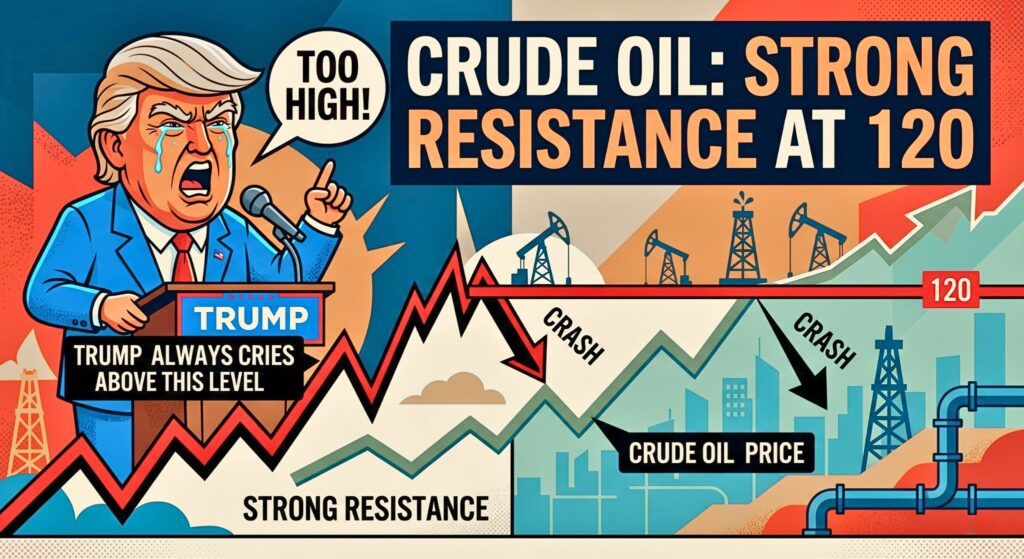
There is a pattern in crude oil markets that has repeated itself with remarkable consistency in recent years: whenever crude oil approaches or breaches the $120 per barrel mark, political pressure — particularly from the United States — mounts with such intensity that the rally inevitably breaks down. And at the centre of this dynamic, especially when Trump-aligned political forces are active, is a very loud and very effective response that has come to define modern crude oil price action.
For traders, $120 is not just a technical resistance. It is a politically enforced ceiling — a threshold beyond which the political cost of high energy prices in the US becomes unacceptable, and extraordinary measures are deployed to bring prices back down. As of April 20, 2026, WTI crude is trading at approximately $89 per barrel (up over 6% on the day) and Brent crude is at $95 per barrel, driven by a sharp escalation in US–Iran tensions after the US Navy seized an Iranian-flagged cargo vessel in the Gulf of Oman. On MCX India, crude is trading at approximately ₹7,715 per barrel. With $120 still some $25–$31 away, the setup remains highly relevant — this is exactly the kind of geopolitical trigger that could accelerate the move toward that critical resistance.
The History of $120: Why This Level Is Different
- 2008: WTI crude touched $147/barrel before the Global Financial Crisis caused a catastrophic demand collapse
- 2011–2014: Brent crude sustained above $100 before US shale oil flooded the market
- 2022: Russia-Ukraine war pushed Brent to $128 — the US announced unprecedented SPR releases of over 1 million barrels/day, engineering a price crash
Each time, $120 acted as the trigger point where political response became inevitable. Above this level, US gasoline prices create genuine electoral pain, forcing the sitting administration to take aggressive action regardless of party affiliation.
The Trump Factor: Louder, Faster, and More Direct
Trump’s public responses on oil prices have historically included:
- Direct calls to OPEC leadership demanding production increases
- Threats of tariffs or sanctions against uncooperative OPEC member nations
- Social media posts calling out Saudi Arabia or OPEC by name — often moving prices immediately
- Announcements of SPR releases or expanded domestic production permits
- Pressure on the Federal Reserve to cut rates
This creates a specific market dynamic: the closer crude gets to $120, the more vocally resistant US political figures become, and markets — anticipating intervention — often begin selling the rally before it reaches that level.
Technical Analysis: $120 as a Double Resistance
- A major psychological round number — markets consistently respect round numbers
- The 2022 post-Ukraine war high — prices exhausted buyers here before a major reversal
- A Fibonacci extension level from the COVID lows to the 2022 highs
- The level at which US shale oil production becomes maximally profitable, incentivising a flood of new supply
For MCX crude oil traders in India, the equivalent level (adjusting for current USD/INR rates of ₹85–₹86 per dollar) is approximately ₹10,200–₹10,320 per barrel. Currently, MCX crude is at ₹7,715 per barrel, which means there is still approximately ₹2,500–₹2,600 of upside potential before this critical resistance zone is tested. Track our real-time Crude Oil Price Forecast for updated technical levels.
How Indian Traders Should Position Around the $120 Level
- Fade the rally near $115–$120: Reduce long positions or initiate short positions with defined stop-losses above $125.
- Watch for political headlines: Any White House statement on oil prices near this level is a significant trading signal.
- Buy dips after the correction: When political response forces crude below $100, accumulate long positions for the next cycle.
- Hedge fuel-sensitive sectors: Airlines, transport, and paint companies should hedge aggressively when crude approaches $120.
Calculate your commodity trading costs using our Brokerage Calculator and explore our Commodities Trading guide for more strategies.
Impact on India’s Economy
For India — which imports approximately 85% of its crude oil needs — prices above $120 per barrel create significant headwinds:
- Widening current account deficit, putting pressure on the Indian rupee
- Rising import bill adding to fiscal stress
- Petrol and diesel price hikes affecting inflation and consumption
- Negative impact on aviation, logistics, paints, tires, and fertilisers
- Potential RBI tightening of monetary policy to contain inflation
Frequently Asked Questions (FAQs)
Q1: Why is $120 such a strong resistance for crude oil?
At $120, US gasoline pump prices rise to politically unacceptable levels, triggering aggressive government intervention including SPR releases, OPEC pressure, and diplomatic measures. Technically, it also represents a historical high from the 2022 Russia-Ukraine spike that exhausted buyers.
Q2: How does Trump specifically affect crude oil prices?
Trump uses direct communication, OPEC pressure, sanctions threats, and domestic production expansion to bring oil prices down. His approach is more vocal and direct than other presidents, and markets factor in his likely response as crude approaches $120.
Q3: What happens to Indian markets when crude crosses $120?
India faces a wider current account deficit, rupee depreciation, higher inflation, and pressure on fuel-dependent sectors. The RBI may respond with tighter monetary policy, which can also pressure equity markets.
Q4: What is the MCX equivalent of $120 crude oil?
At the current USD/INR rate of approximately ₹85–₹86, $120 per barrel translates to approximately ₹10,200–₹10,320 per barrel on MCX. Currently, MCX crude is trading at ₹7,715/barrel, giving $120/bbl resistance approximately ₹2,500 higher. Traders should monitor this level carefully as global geopolitical tensions continue to push prices upward.
Q5: How can traders profit from the crude oil $120 resistance?
Disciplined traders fade the rally near $115–$120, use tight stop-losses above $125, and rotate to short positions. When political intervention forces a correction, buying the dip below $95–$100 has historically been profitable in preparation for the next cycle.


 Angel One (Trading & Demat Account)